Preview payments are in test mode.
The Four Lines

The Practice

A guide to reading the hand

The traditional system of palmistry, set out plainly. Use it to read your own hand, or anyone's.

Before you begin

Good reading starts with good looking. These are the conventions readers use before interpreting a single line.

Which hand to read

Tradition reads the dominant hand as the self you have developed, and the non-dominant hand as your natural disposition. Comparing the two is one of the most revealing things a reader can do: where they differ, the person has changed.

For a single reading, use the dominant hand. For most people that is the right.
Light and posture

Hold the hand open and relaxed, fingers slightly apart, in soft daylight from the side. Raking side light shows depth; flash flattens the fine lines and hides markings.

Cup the hand slightly to see the minor lines and mounts in relief.

Fingers and thumb

Compare each finger to the length of the palm. Long fingers are associated with patience and attention to detail; short fingers with speed and a view of the whole.

A long index finger is read as confidence and a wish to lead; a ring finger longer than the index as creativity and appetite for risk. A firm thumb that resists being bent back suggests determination; a flexible one, adaptability.

Skin, colour and consistency

Fine skin is traditionally associated with sensitivity; coarse skin with robustness. A firm palm suggests energy and a springy resilience; a soft palm, a love of comfort.

These qualities colour everything else: a strong heart line on a soft hand reads differently from the same line on a firm one.

Reading line quality

For every line, readers ask the same questions: where does it begin and end, how deep is it, is it clear or chained, does it break, and does it branch?

A deep, clear line suggests the quality it represents flows easily. A faint line suggests it is present but less emphasised. A break suggests change, never harm. Upward branches are read as encouraging, downward branches as effort or dispersal.

Hand shape

Before any line, a reader looks at the whole hand. Traditional palmistry groups hands by the four elements, judged by the ratio of palm to fingers.

Earth

A square palm with short fingers. Associated with practicality, steadiness and a preference for what can be touched and built.

Air

A square palm with long fingers. Associated with curiosity, communication and a restless, analytical mind.

Water

A long, narrow palm with long fingers. Associated with sensitivity, intuition and a rich inner life.

Fire

A long palm with short fingers. Associated with energy, enthusiasm and impatience with routine.

The major lines

Most palms carry three clear lines, and many carry a fourth. Readers consider length, depth, curve, and where a line begins and ends.

Heart line

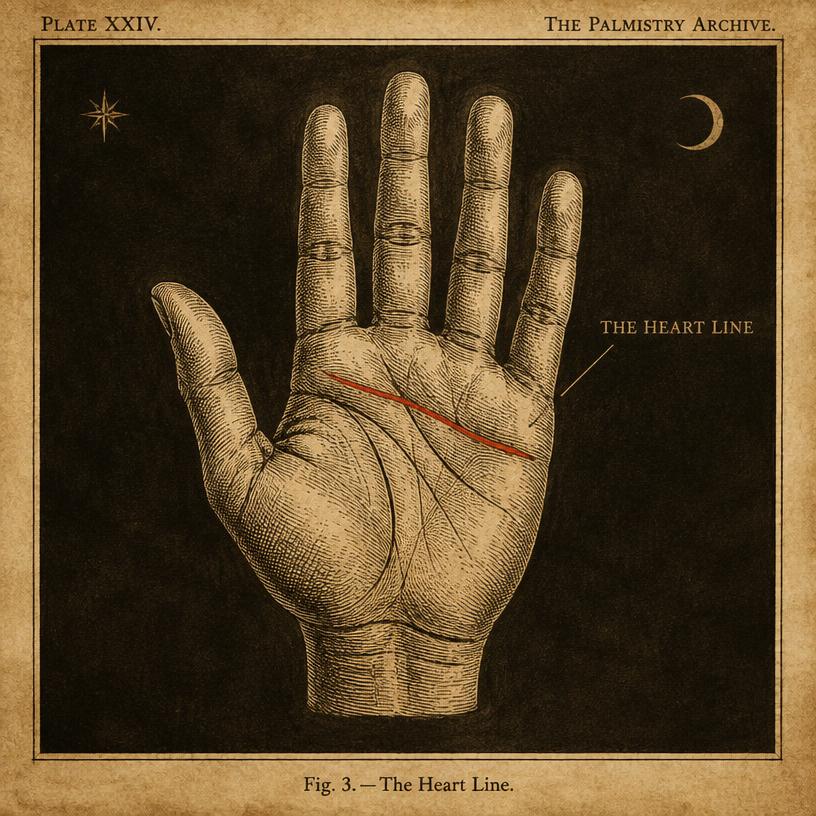
The highest horizontal line, running beneath the fingers. It concerns emotional life: how you attach, express and protect feeling.

A line curving up toward the index finger is traditionally read as warm and idealistic; one running straight across as reserved and mental in its affections. Breaks are read as emotional turning points rather than misfortunes.

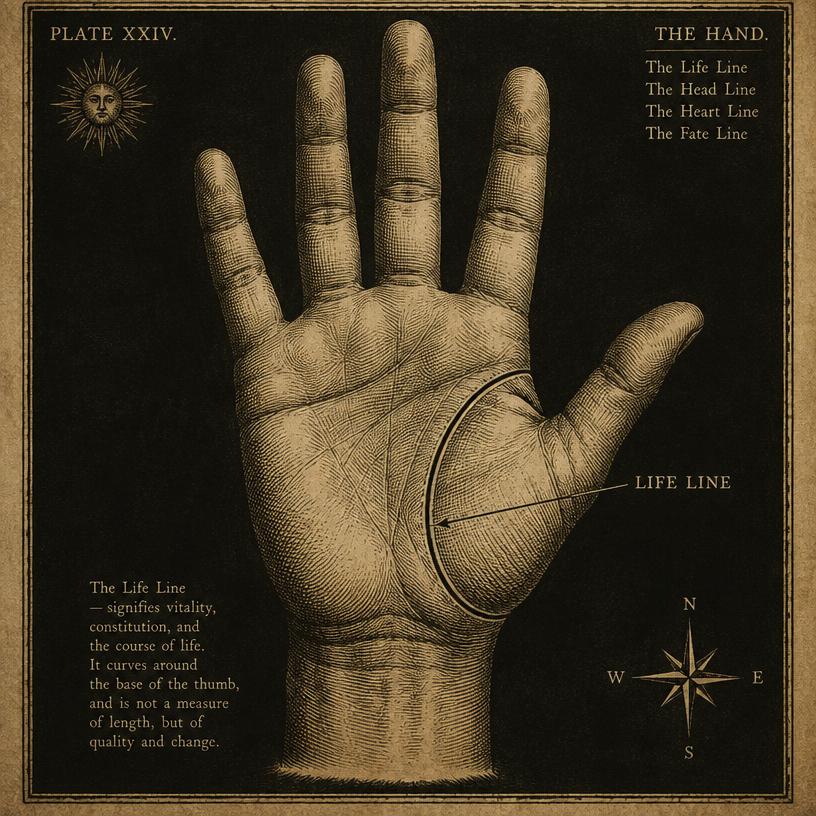
Life line

Curving around the base of the thumb. Despite its name, it is not read as length of life. It describes vitality, stamina and the major changes of one's circumstances.

A wide arc suggests energy and appetite for experience; a line hugging the thumb, caution and a preference for the familiar.

Fate line

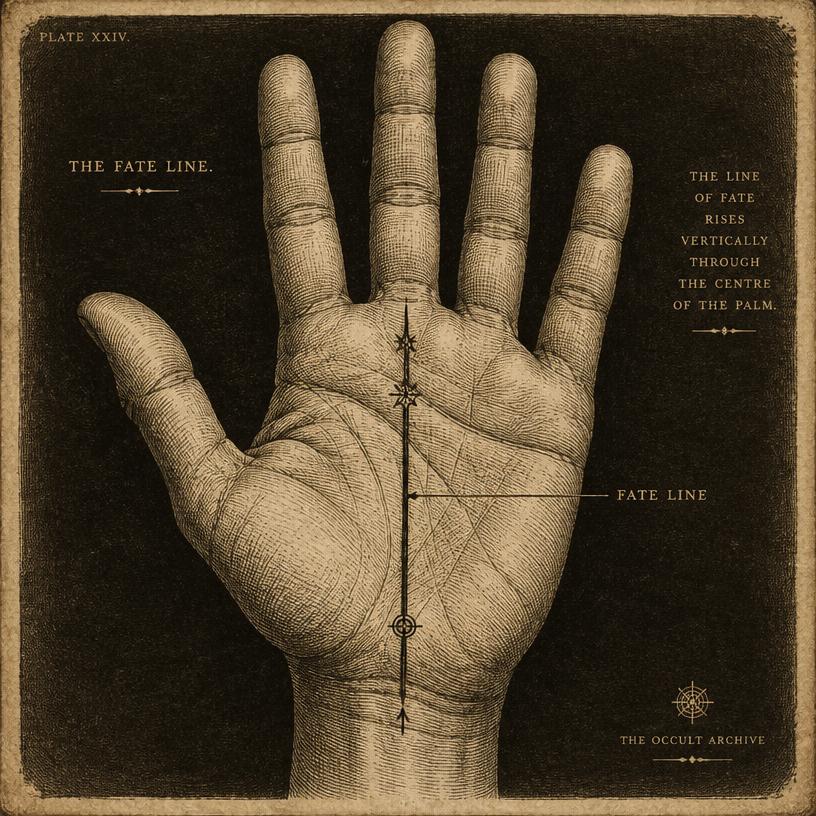
A vertical line rising toward the middle finger. Not everyone has one. It is associated with direction, vocation and the sense of being on a path.

A strong line suggests a clear course; a faint or broken one, a life shaped by choice and reinvention.

Minor lines

Smaller lines add detail to the picture drawn by the major ones.

Sun line

Rising toward the ring finger; associated with creativity, recognition and contentment.

Mercury line

Running toward the little finger; associated with communication and commercial sense.

Relationship lines

Short horizontal lines on the edge of the palm below the little finger; read as significant bonds.

Girdle of Venus

An arc above the heart line; associated with heightened sensitivity.

Travel lines

Small horizontal lines at the outer lower palm; associated with journeys, changes of place, or a pull toward unfamiliar settings.

Intuition line

A curved line along the outer palm; associated with instinctive perception and sensitivity to atmosphere.

Simian line

A single crease where the heart and head lines are merged. Present in roughly one to four percent of hands, it suggests thought and feeling operate with unusual intensity and little separation.

The mounts

The fleshy pads of the palm are named for classical planets. A full, firm mount emphasises its quality; a flat one suggests it plays a quieter role.

Jupiter

Beneath the index finger. Ambition, leadership, confidence.

Saturn

Beneath the middle finger. Discipline, responsibility, seriousness.

Apollo

Beneath the ring finger. Creativity, taste, optimism.

Mercury

Beneath the little finger. Wit, persuasion, adaptability.

Venus

At the base of the thumb. Warmth, sensuality, love of life.

Moon

Opposite Venus, at the outer base of the palm. Imagination, intuition, the inner world.

Mars

Upper and lower Mars sit either side of the palm's centre. Courage and resilience.

Markings

Small signs on a line or mount qualify what is around them.

Star

Several short lines crossing at a point. Read as a moment of intensity, often a notable success.

Cross

Two lines crossing. Read as a challenge or a decisive change.

Island

A small oval in a line. Read as a period of divided energy or strain.

Triangle

Three lines forming a small triangle. Associated with skill and aptitude.

Grille

A small lattice of lines, often on a mount. Read as scattered effort in that area.

Square

Four short lines enclosing an area, often over a break. Traditionally read as protection or containment around a difficult period.

Chain

A linked sequence of small islands. It suggests a quality expressed unevenly or with repeated friction.

Fork

A line dividing into two clear branches. It suggests two modes of expression or an ability to hold different perspectives.

Putting it together

No single feature means much on its own. The craft lies in reading them as a whole.

An order of reading

Start with the hand shape, it sets the temperament everything else is read against. Then the heart and head lines, and how they relate. Then the life and fate lines, the minor lines, the mounts, and last the markings, which qualify what came before.

Look for agreement: a strong Mount of Jupiter, a long index finger and a heart line rising to Jupiter all say the same thing, and repetition is what gives a reading weight.

Look for tension

The most interesting readings come from features that disagree: a practical earth hand with a steeply sloping, imaginative head line; a guarded heart line on a warm, full Mount of Venus. Name the tension rather than resolving it, that is usually where the person recognises themselves.

Know the limits

Palmistry describes tendencies, not destiny. Never read length of life, illness, pregnancy or fortune from a hand. A good reading leaves the person with a question about themselves, not an answer about their future.